

When some nurse leaders hear the words servant leadership, they picture a leader who is endlessly patient, avoids conflict, and makes sure everyone feels good. That is not servant leadership.
A servant leader absolutely cares about people. They listen, coach, develop, encourage, and create an environment where others can succeed. But they also establish expectations, address poor performance, protect standards, and hold people accountable when their actions affect the team or patient care.
That combination is what makes servant leadership so effective in a hospital.
What Is Servant Leadership?
Robert Greenleaf introduced the modern concept of servant leadership more than 50 years ago. The basic idea is simple: leadership begins with a desire to serve others and help them grow. The leader does not give away authority. Instead, the leader uses that authority to help other people become more capable, confident, and successful.
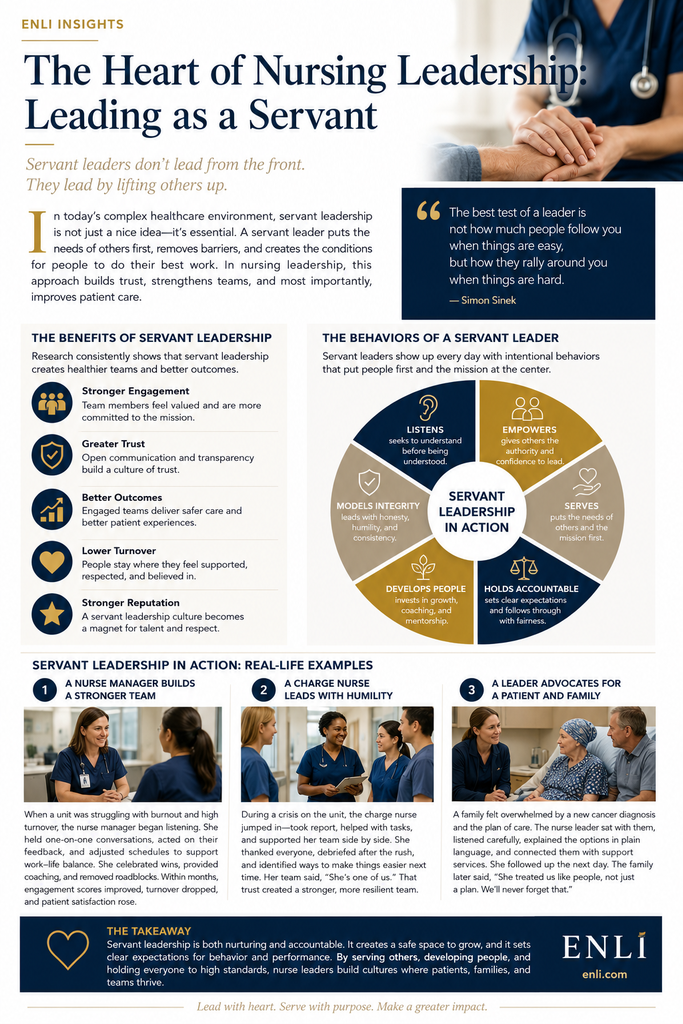
Research on servant leadership identifies behaviors including listening, empathy, humility, stewardship, empowerment, authenticity, courage, and accountability. That last word matters. Accountability is part of servant leadership, not the opposite.
What Does a Servant Nurse Leader Actually Do?
In a hospital, servant leadership becomes visible in everyday behavior.
A servant nurse leader:
- Listens before reacting. They understand what happened before deciding what needs to happen next.
- Makes expectations clear. Staff should never have to guess what acceptable performance looks like.
- Removes barriers. If nurses lack equipment, education, information, or resources, the leader works to correct it.
- Develops people. They coach new nurses, prepare charge nurses for leadership, and help experienced nurses keep growing.
- Shares credit. When the team succeeds, the team gets recognized.
- Accepts responsibility. When leadership decisions contribute to a problem, the leader owns their part.
- Addresses poor performance. Compassion does not mean ignoring unsafe practice, disrespectful behavior, repeated lateness, failure to follow policy, or lack of accountability.
- Protects the patient and the team. One employee's needs cannot consistently outweigh the safety and effectiveness of everyone else.
Research involving hospital nurses has found that units where nurse managers demonstrate stronger servant-leadership behaviors also report higher employee job satisfaction. Broader nursing leadership research has also identified positive relationships between effective nurse leadership and patient safety, quality of care, error reporting, and patient satisfaction.
Servant Leadership in the Real World
Example 1: Developing the Team
At a large Midwestern university hospital, a nurse manager recognized that several experienced staff nurses wanted to advance professionally but were unsure how to move into formal leadership roles. Rather than simply telling them to apply for open positions, the manager met with them individually, learned about their professional goals, and identified development opportunities.
The manager created opportunities for them to lead huddles, participate in committees, mentor newer nurses, and take on charge nurse responsibilities. At the same time, expectations remained clear regarding attendance, clinical performance, teamwork, and professional behavior.
This is servant leadership in action. The leader invests in the individual while protecting the department's standards and performance expectations.
Example 2: Serving Staff, Patients, and Families
At a large Southeastern community hospital, a patient received an unexpected diagnosis that required additional testing and a complicated treatment plan. The patient and family were overwhelmed by the amount of information they were receiving and became increasingly frustrated with the care team.
The nurse leader became involved rather than simply referring the concerns to another department. The leader met with the patient and family, listened to their concerns, clarified the plan of care, coordinated communication among physicians and nursing staff, and ensured the family understood what would happen next.
The leader also met privately with members of the nursing team after concerns were raised about inconsistent communication. Rather than blaming staff, the leader reviewed what occurred, clarified expectations, identified where communication had broken down, and established clear expectations for future patient and family updates.
The patient and family received greater support, but the staff was also held accountable for improving their performance. That balance is the essence of servant leadership.
The Leadership Question
At the end of the day, servant leadership is not about being the nicest person in the department. It is about using your position to help people improve while protecting the standards that patients, families, employees, and the organization depend on.
Ask yourself this week:
Do the people I lead know that I care about their success, and do they know exactly what I expect from them?
If the answer to both questions is yes, you are beginning to understand what servant leadership really looks like.
0 Comments